Most people think unclogging a toilet is about force — push harder, plunge faster, hope for the best.
But the truth is, unclogging performance isn’t about brute strength. It’s about how effectively force is transferred through the system.
This is where hydraulic plungers separate themselves from traditional tools.
In this article, we’ll break down the engineering principles behind hydraulic pressure, how it interacts with toilet design, and why water-powered plungers deliver superior real-world results.
Understanding the Toilet Trapway System
To understand clog removal, you first need to understand where clogs actually occur.
Every toilet contains a built-in curved channel called the trapway. This passage:
- Holds standing water to block sewer gases
- Narrows at key points
- Creates natural resistance during flushing
Most clogs occur in this curved section, where:
- Toilet paper compacts
- Waste slows down
- Debris collects at restriction points
This means any unclogging method must push material through a curved, narrow, water-filled pathway — not just dislodge it at the surface.
Air vs. Water: The Physics That Changes Everything
The biggest difference between plunger types comes down to one principle:
Compressibility
- Air compresses easily → absorbs energy
- Water does not compress → transfers energy
What this means in practice:
When using a traditional plunger:
- A portion of your effort compresses air
- Energy is lost before it reaches the clog
- Pressure fluctuates and weakens
When using a hydraulic (water-powered) plunger:
- Force is transferred instantly
- Pressure remains consistent
- Energy is delivered directly into the blockage
This is the core reason hydraulic plungers outperform traditional designs.
Pressure Waves: How Hydraulic Force Travels Through Pipes
When a hydraulic plunger is activated, it creates a pressure wave inside the water column.
This wave:
- Travels rapidly through the trapway
- Maintains its strength through bends
- Concentrates force at restriction points
- Pushes debris forward instead of dispersing it
Unlike air pulses, which dissipate quickly, water-based pressure waves remain cohesive and effective — even through curves and tight spaces.
Why Seal Integrity Matters Less with Water
Traditional plungers require a perfect seal to function effectively.
Even a small air leak can:
- Break suction
- Reduce pressure
- Cause splashback
Hydraulic systems behave differently.
Because water naturally fills gaps:
- The system self-seals
- Pressure distributes evenly
- Performance is more consistent
This makes water-powered plungers far more reliable for average homeowners.
The Role of Force Concentration
Not all force is equal — how it’s delivered matters.
Hydraulic plungers focus force into a narrow, directed column of water, which:
- Targets the clog directly
- Increases penetration power
- Minimizes wasted energy
Traditional plungers spread force over a wider area, reducing effectiveness.
Think of it like this:
- Air plunging = pushing broadly
- Hydraulic plunging = driving force precisely where it’s needed
Interaction with Modern Low-Flow Toilets
Modern toilets use less water per flush, which creates a new challenge:
- Less volume = less natural clearing force
- Narrower trapways = higher clog risk
Hydraulic plungers compensate for this by:
- Reintroducing force into the system
- Delivering pressure beyond what a flush can achieve
- Clearing blockages that low-flow systems leave behind
This makes them especially effective in homes built or updated after the 1990s.
How the Johnny Jolter Applies These Engineering Principles
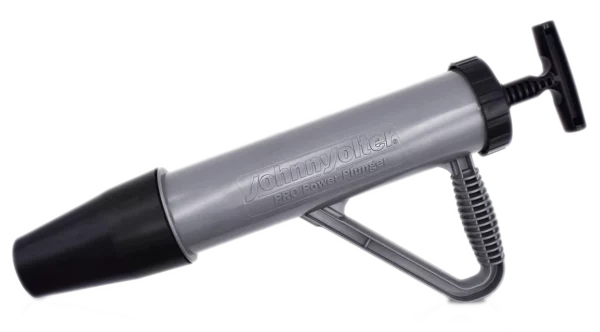
The Johnny Jolter No-Mess Plunger is built specifically around hydraulic efficiency.
Its design focuses on:
✔ Water Chamber Compression
Uses the existing bowl water to create a pressurized system.
✔ Directed Pressure Delivery
Channels force into a concentrated surge aimed directly at the trapway.
✔ Check Valve System
Prevents backflow and splashback — keeping the process clean and controlled.
✔ Optimized Force Transfer
Maximizes output from minimal user effort.
✔ Consistent Performance
Removes variability caused by poor seals or air leaks.
This is not just a different plunger — it’s a tool engineered around fluid dynamics and real-world performance.
Why Hydraulic Plungers Reduce Repeat Clogs
One overlooked advantage of hydraulic plunging is completeness.
Because the pressure wave travels deeper and hits harder:
- More debris is cleared in one attempt
- Residual buildup is reduced
- Partial obstructions are eliminated
This significantly lowers the chances of:
- Immediate re-clogging
- Slow drainage after clearing
- Ongoing plumbing frustration
Clearing a toilet clog isn’t about how hard you push — it’s about how efficiently force moves through water.
Hydraulic plungers use the fundamental physics of non-compressible fluids to deliver stronger, more consistent, and more targeted unclogging power.
The Johnny Jolter No-Mess Plunger takes these engineering principles and applies them in a way that’s simple, clean, and highly effective for everyday use.
If you want a solution that works with physics — not against it — hydraulic pressure is the proven method.